Discovering mice in your home can make you feel unsettled and out of control. Even just a small amount of scratching behind a wall or a single sighting in the kitchen is enough to set off the worry that there may be more you haven’t seen yet. It’s understandable that many people look for quick, natural ways to push mice away before going down the route of traps or hiring a professional. Cayenne pepper is one of those common suggestions, often shared online as a simple home remedy — but does it actually work?
There’s an important difference between repelling mice and removing mice. Cayenne pepper is sometimes said to deter them because of its strong, irritating qualities. But deterring is only one part of the picture. To stop mice for good, you need to remove entry points, eliminate food access, and break their travel paths. Cayenne pepper can only play a small role in part of that bigger solution.
This guide will walk you through how cayenne pepper affects mice, how to use it if you choose to, where it falls short, and what actually stops mice returning. By the end, you’ll be able to make an informed decision about whether it’s worth trying at all — and how to approach mouse prevention properly.
What the Claim Says
Many online home remedy discussions claim that cayenne pepper repels mice by irritating their nasal passages and deterring them from crossing treated areas. The idea is that the spice is too unpleasant for them to tolerate, making them avoid certain parts of your home.
The theory behind cayenne and mice
Cayenne pepper contains capsaicin — the compound responsible for the burning heat associated with chilli peppers. In strong concentrations, capsaicin can irritate the nose, eyes and skin. The logic is that if it bothers humans, it will also bother mice, encouraging them to stay away.
Why it seems like a simple fix
Cayenne pepper is widely available, inexpensive, and doesn’t require special tools. It’s something most people already have in their kitchen cupboard, making it feel like a fast, low-effort solution.
When people usually attempt it
People often try cayenne pepper in areas like:
- Under the sink where pipe gaps are visible
- Behind appliances where mice travel unseen
- In garages and sheds
- Along skirting boards
- Around loft access points
These are all places where mice either enter or pass through — but whether cayenne makes a difference depends on other conditions too.
The Evidence: Does Cayenne Pepper Actually Repel Mice?
Cayenne pepper may cause temporary discomfort to mice when they come into direct contact with it. However, mice are highly adaptable creatures. When they know there is a reliable food source or nesting area available, they are willing to tolerate short-term irritants to reach it.
What pest control professionals observe
Professionals generally report that cayenne pepper provides very limited benefit. If a mouse encounters it directly and sniffs it closely, the irritation may cause hesitation. But because the effect relies on scent and contact, real-world results are inconsistent.
What tends to happen in practice
In real homes:
- Cayenne pepper gets scattered or blown out of place easily.
- Mice can walk around treated spots instead of through them.
- Smell-based deterrents fade quickly.
- Mice quickly return if food remains accessible.
Key limitations
- Cayenne pepper does not stop new mice entering from unseen points.
- It does not remove existing nests or breeding activity.
- It only works in very small, controlled areas, and even then only sometimes.
So while cayenne pepper may briefly discourage a passing mouse, it cannot resolve a mouse problem alone.
How to Use Cayenne Pepper If You Choose To
This is the only section with bullet points, as requested.
If you still want to try cayenne pepper, use it strategically, not randomly:
- Identify where mice travel by looking for droppings, rub marks, or chewed materials.
- Concentrate cayenne pepper directly in those narrow access points.
- Create small lines or clusters of spice rather than spreading it widely.
- Combine it with cleaning, food sealing, and surface wiping to reduce attractants.
- Reapply after cleaning, sweeping, or airflow disturbance.
- Avoid placing cayenne pepper where children, pets, or bare feet may contact it.
Used this way, cayenne pepper can sometimes interrupt a mouse’s route — but only as a very small part of a larger prevention plan.
Why Cayenne Pepper Alone Won’t Stop Mice
Mice are drawn to:
- Warmth
- Nesting materials
- Easy food access
- Safe, hidden travel routes
If these things are present, no scent is strong enough to convince them to leave.
Mice adapt quickly
If a route becomes uncomfortable, mice will simply find another. They are more determined than many people expect.
Scents fade
Cayenne pepper loses strength as it is touched, moved, or exposed to air. Once the smell weakens, the deterrent effect disappears.
The real priority: proofing the home
Blocking points of entry and removing food availability are what change the situation.
Other Natural Scents People Try
Cayenne pepper often comes up alongside other natural deterrents. These can play a supporting role, but again, none of them act as complete solutions.
Lavender
Lavender is used because of its strong, calming scent for humans and its potential to disrupt rodent scent trails. Some people place lavender oil on cotton pads in cupboards and under sinks to discourage mice from exploring. However, the scent fades quickly. Lavender can be helpful in the very final stage of prevention after sealing gaps and storing food properly — not before.
Citronella Oil
Citronella oil is better known as an outdoor insect repellent, but its sharp fragrance leads some people to use it indoors. It may cause mild avoidance for mice in certain small areas, but it works best only when constantly refreshed. Like cayenne and lavender, it should be considered a supporting measure, not a solution.
Peppermint and eucalyptus
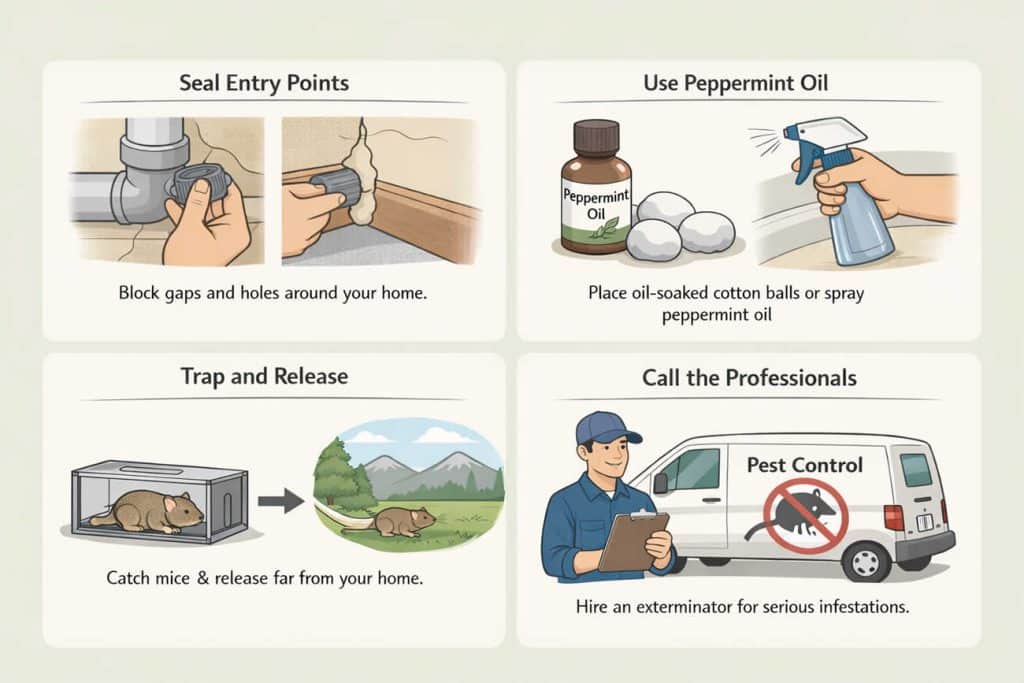
These oils can create short-term scent barriers, but they require frequent reapplication and precise placement.
A Practical Weekend Mouse-Proofing Plan
This is where most results come from — not from scents, but from controlling access.
Inspect entry points
Check:
- Under the kitchen sink
- Around appliances
- Behind bath panels
- Where pipes enter walls
- Under doors and along skirting boards
Mice only need a gap the width of a pencil.
Seal openings
Use:
- Steel wool packed into gaps
- Sealant applied over the steel wool
- Door sweeps on gaps under doors
These materials are chew-resistant.
Secure all food
Store food in airtight containers. Wipe counters nightly. Keep pet bowls empty overnight.
Place traps
Traps work best along walls, not in open spaces.
Only now consider scent deterrents
Cayenne pepper, lavender, citronella, peppermint — these are finishing touches, not the foundation.
Troubleshooting & When to Seek Help
If you still see:
- New droppings
- Fresh gnaw marks
- Noises in the walls at night
- Shredded paper or fabric
Then you may still have an entry point or nest location you haven’t identified.
In these cases, thorough re-inspection is essential.
If the issue continues beyond 2–3 weeks of consistent effort, it may be time to involve a professional, especially if the problem is spreading across multiple rooms or floors.
Our Final Say
Cayenne pepper can have a mild, temporary effect on mice when placed directly on their travel routes. However, it is not reliable enough to use as a standalone solution. Mice are resourceful and persistent, and they will return if your home still offers warmth, shelter and accessible food.
The real key to stopping mice is:
- Sealing entry points
- Maintaining consistent cleanliness
- Using traps to interrupt active travel
- And only then, if desired, adding scent deterrents like cayenne pepper, lavender, or citronella
Cayenne pepper is best used as a small supporting measure — not the strategy itself.
With the right approach, you can regain control of your home and prevent mice from returning.