You’re probably here because you’ve spotted signs of mice and you don’t really want to go straight to poison or snap traps. Maybe it’s a rented place. Maybe you’ve got pets or children. Or maybe you just like the idea of keeping rodents out with natural smells instead of harsh chemicals. Citronella comes up a lot when people talk about scent deterrents for pests, but most of the time they’re talking about insects, not mice.
So the big question is simple: can citronella oil actually make mice stay away, or is it one of those things that sounds good but doesn’t do enough on its own? Let’s walk through it carefully and build something you can actually use in your home.
Why homeowners look for smell-based mouse deterrents
You look for smell-based mouse control because it’s low effort, low cost and low risk. You don’t have to set anything messy. You don’t have to block off rooms. You don’t have to worry about secondary poisoning. You just put a smell down and hope the mouse thinks, “No thanks.”
It’s an attractive idea, especially when you want to protect a kitchen, a pantry, a shed or a loft without filling it with traps. Scent deterrents also feel more everyday than calling in a pest controller straight away. You can try them first and, if they work, you’ve saved yourself money and hassle.
Where citronella sits among natural remedies
Citronella is in the same group as peppermint, eucalyptus, clove, cinnamon and vinegar – strong, intense, sometimes sharp smells that can overwhelm a mouse’s very sensitive nose. All of those get mentioned again and again across pest control blogs, because mice really do rely on scent to find food, to follow trails and to feel safe.
Citronella doesn’t sit at the very top of the mice-hate-this list – peppermint and menthol scents usually get that spot – but it is mentioned as useful, especially around doors and windows and in summer months. Think of citronella as a supporting smell, not the star.
What this guide will cover
You’ll see how mice actually use smell, why some odours work better than others, where citronella can help, how to apply it properly, what to mix it with, what to do in the rest of the house, and when to stop trying scents and bring in traps or professionals. That way you don’t waste time repeating something that won’t fix a bigger problem.
Why Mice Come Into Homes
Mice don’t come in because they love your décor. They come in because you’ve got three things they want: food, warmth and shelter. If your property offers any of those consistently, they will keep trying to enter, even if it smells a bit odd.
That’s the first thing to understand. Scent can make a mouse hesitate, but a strong food source can make it push through. So you always look at smells and access together.
Common attractants (food, warmth, shelter)
Mice follow crumbs, pet food, bird seed spills, open bins, compost areas, warm boiler cupboards, cluttered lofts and cosy understairs spaces.
If you’ve got insulation, fabrics, cardboard or stored items, that’s even better for them. A house that’s lived in, busy, and sometimes not cleaned fully in the corners is always going to be more attractive than a house that smells of citronella but has food lying about. Clean first, repel second.
How mice use scent trails and pheromones
Mice like to move along the same safe runs. They leave scent behind. Other mice follow it. If you cut that trail, or you cover it with something stronger, you can interrupt that pattern.
That’s why people talk about vinegar or essential oils on skirting boards and entry points – the idea is to make the path too confusing to follow. Citronella can help with that because it’s punchy and it lingers for a bit.
Why blocking smells can sometimes interrupt behaviour
If a mouse can’t smell food, can’t smell other mice and can’t smell safety, it can decide this room isn’t worth the risk. That’s the whole theory behind smell-based mouse deterrents: you make the area feel busy or threatening to their nose.
But it’s a push, not a guarantee. If the reward is high, the smell may not stop them. If the reward is low, the smell is more likely to work.
How Scent-Based Repellents Work
Scent-based repellents work by overloading the rodent’s sense of smell. Mice have an extremely powerful olfactory system and an extra organ for detecting chemical cues, so they do notice strong smells very quickly. When the smell is too powerful or too strange, the mouse chooses an easier route.
That’s why you’ll see peppermint, spearmint, clove, cinnamon, lavender, vinegar and yes, citronella, all recommended in slightly different ways.
Why strong, sharp, or unfamiliar odours bother mice
These odours do two things. First, they mask the scents the mouse wants to follow. Second, they create irritation in the nose. If you’ve ever put too much menthol near your own face, you know the feeling. Mice get that too.
So they choose somewhere else if they can. Citronella contains citronellal, which can overwhelm the senses of rodents, so it does fit the pattern.
Limits of smell-only approaches
Smell fades. Doors open. Windows get draughts. You forget to reapply. A hungry mouse gets bold. That’s why every solid guide on this topic says the same thing: use scents as part of a plan, not as your whole plan.
If you only use citronella, and you leave gaps under doors and food in the garage, you’ll still get mice.
Situations where smells help (light activity, prevention, small spaces)
Smells work better when you’ve only seen one mouse, or you only get occasional visits, or you’re trying to protect a single cupboard, motorhome, shed or loft corner.
They also help when you’ve already cleaned, already sealed and you just want extra insurance. In those cases, citronella is totally reasonable to try.
What Is Citronella Oil?
Citronella oil is made from scented grasses and is best known as a natural insect repellent. Most people know it from summer candles and outdoor sprays. It has a citrusy, sharp, slightly grassy smell that most people find fresh and summery.
It contains citronellal and geraniol, which are the active parts that tend to bother pests.
Where citronella comes from
It’s steam-distilled from the leaves and stems of the plant, giving you a concentrated essential oil. That’s important, because with mice you don’t want a weak scent, you want a strong version you can dilute and place deliberately.
Usual uses (insects, candles, diffusers)
Citronella is mainly used for mosquitoes, midges and flies. You see it in patio candles, garden torches, plug-in diffusers and room sprays. That’s why people think, “If it works for insects, maybe it’ll work for rodents.” It’s a fair thought, but insects and rodents don’t react exactly the same way, so the effect on mice is more modest.
Why people think it might work on rodents
Because pest blogs now list citronella right alongside peppermint, cinnamon, clove and vinegar as a smell mice don’t like. They usually say the same thing: it can overwhelm the senses, it can mask food odours, and it’s worth trying in high-risk areas. That’s where this whole idea comes from.
Does Citronella Oil Repel Mice?
Short answer: it can help, but it’s rarely enough on its own. It’s a deterrent, not a remover. It may make a mouse turn away from a treated spot. It may make an exposed gap less attractive. It may make an indoor bin area, boot room or porch less appealing. But if mice already live in your loft, or they’re already feeding from a pet bowl every night, citronella on the skirting board won’t fix it.
How mice are likely to react to citronella
They will notice it straight away. Some will avoid it. Some will detour. Some will ignore it if they’re desperate. That’s the truth with all smell-based mouse control. You’re influencing behaviour, not controlling it.
When citronella may help (entry points, cupboards, garages)
This is where citronella makes sense: door thresholds and patio doors, under-sink cupboards, utility rooms, small garages or garden rooms, caravan or holiday lets that get the odd mouse. In these places, one or two mice are testing the space. You make it smell unfriendly, so they try somewhere else.
When citronella won’t work (established nests, plenty of food, heavy activity)
If you’ve got droppings in several rooms, chewed packaging, scratching in the walls or attic, or a clear nest, that’s telling you the mice are settled. A settled mouse is harder to move with smell alone, because it already feels safe and it already knows where the food is. At that point you bring in traps or a pest controller.
Citronella vs stronger rodent-repelling oils
Peppermint and menthol-based oils still have the edge for mice. Clove and cinnamon are good for masking trails. Vinegar is good for cleaning and disrupting. Citronella is another tool, but not the strongest one in the box. That’s why rotating smells is smart – you don’t let the mouse adapt.
How to Use Citronella Oil Safely and Effectively
You get the best results when you use the oil in a targeted way instead of just making the whole room smell nice. You go straight to the routes the mouse is using and you scent those. You also keep reapplying, because essential oils evaporate.
Cotton wool / pad method at access points
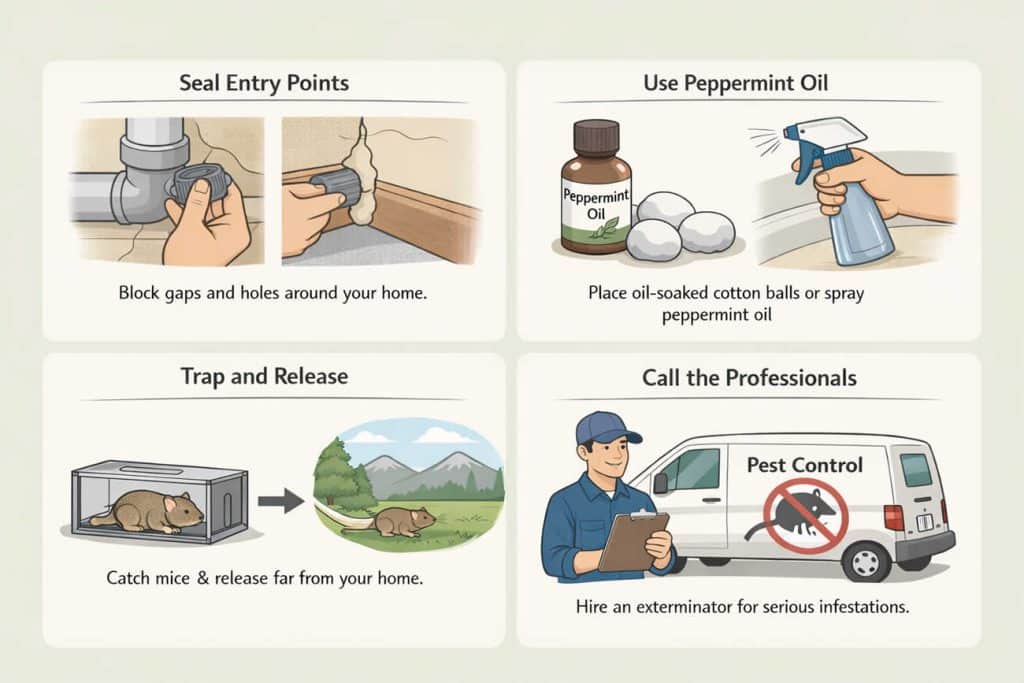
Put a few drops of citronella oil on cotton wool, make sure it’s damp but not dripping, and tuck it into the corner by the pipe, behind the washing machine, behind the fridge, or beside the door frame. Replace it every few days, sooner if the area is warm or draughty.
DIY spray for skirting boards and under-sink areas
Mix water, a little white vinegar and several drops of citronella. Shake well. Lightly spray along skirting boards, under sinks, around cupboard bases, and anywhere you’ve seen droppings. Test first on paint or flooring. The vinegar helps remove old scent trails and the citronella adds the deterrent layer.
Using citronella in sheds, lofts, and outbuildings
These areas are perfect for oily scents because you don’t mind the smell as much and there’s less fresh air movement. Place treated pads near the door, around stored pet food, and near any gap at roof level. Combine with tidying and sealing.
How often to refresh essential oils
At least twice a week in busy areas. More if it’s warm or breezy. If you can’t smell it, the mouse probably can’t either. Scent deterrents only work while they’re strong.
Other Smells Mice Hate (to rotate with citronella)
Rotating smells gives you a better chance of keeping mice away because they don’t get used to one scent. The sources you looked at all list similar odours, so you’ve got a good menu to pick from.
Peppermint and menthol oils
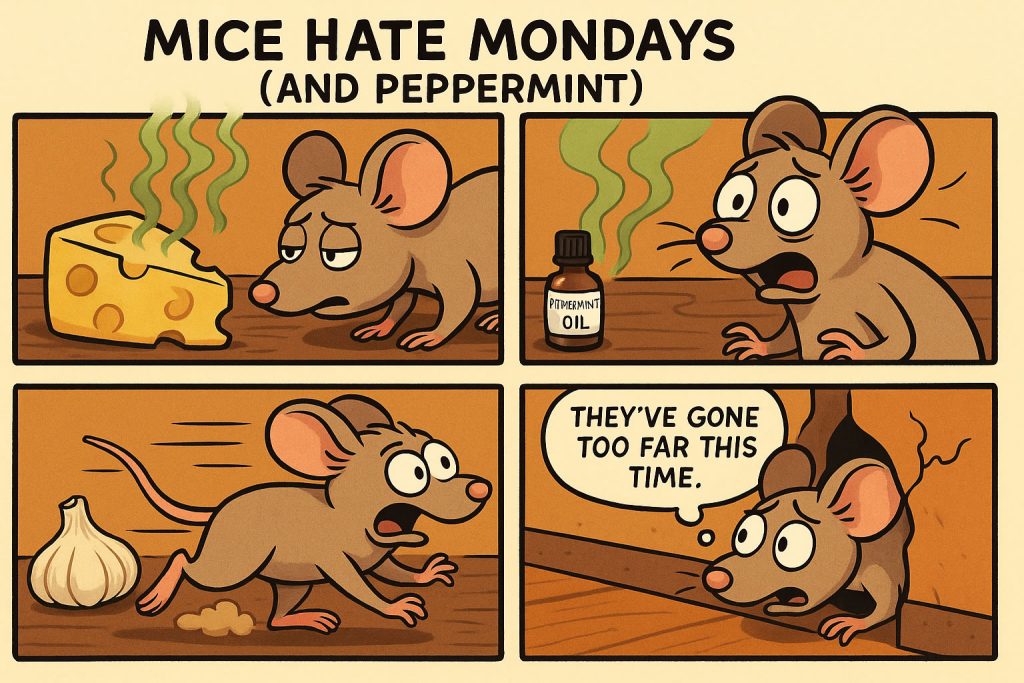
These are the classics. Very strong, very noticeable, good for cupboards and lofts. Many people start with peppermint, then add citronella later.
Eucalyptus / tea tree
Sharper, cleaner smells that can also help with mustiness. Good in bathrooms or utility rooms where mice have been slipping in.
Clove, cinnamon, and spicy aromas
Great for masking pheromones and food smells. Cinnamon can be simmered. Clove can be turned into a spray. Citronella can sit alongside these.
Vinegar / ammonia-type smells
Best for cleaning and cutting trails. These don’t always repel in the same way, but they remove the scents mice like to follow. Use first, then add oils.
Why rotating scents improves results
If a mouse finds peppermint twice, it may realise nothing bad happens and ignore it. If the smell changes every few days – peppermint, citronella, clove, vinegar – the route never feels stable, so it will prefer another path.
Home Remedies That Support Scent Repellents
Smells work far better in a clean, tidy, scent-controlled space. If the room already smells of rubbish, pet food, damp or bird seed, your citronella is fighting uphill. So you start with housekeeping.
Cleaning and odour removal so the repellent stands out
Wipe down surfaces with vinegar and warm water. Mop floors. Clean under appliances. Empty bins often. The point is to remove the smells the mouse wants, so the repellent stands out.
Removing food sources and nesting materials
Put food in sealed tubs. Store cereal, pasta, pet food and treats in plastic or metal. Clear cardboard, cloth, and paper piles from lofts and cupboards. Less food and less bedding means less reason to push past the citronella.
Storing pet food and bird seed properly
These two attract mice constantly. Keep them off the floor, keep the lids tight, and don’t leave pet bowls out overnight. Once you do that, your scent line has a chance.
Seal, Block, and Proof the Property
Every good pest guide says the same thing: you can’t repel what you still let in. Scent helps, but proofing wins. Do both.
Finding and sealing gaps around pipes, doors, and vents
Look under the sink, behind the toilet, where the washing machine hose comes in, and around the boiler pipes. Any gap bigger than a pencil can be a mouse gap. Seal with wire wool and filler, or use purpose-made rodent mesh. Then scent around it.
Protecting lofts, garages, and under-floor spaces
These are entry zones. Block draught gaps, add bristle strips to doors, repair damaged air bricks, and don’t leave garage doors open at night. Then you can place citronella pads right by the repaired area to reinforce it.
Outdoor factors: bins, compost, sheds
If the outside smells like food, mice will keep coming close. Keep bins shut, move bird feeders away from the house, and clear under sheds. Once you reduce activity outside, indoor scent deterrents work better.
When Natural Repellents Aren’t Enough
There’s a point where you stop trying to out-scent the mice and you start removing them. If you’re hearing scratching every night, if you’re finding droppings daily, if you’ve seen gnawing on electric cables or pipe lagging, don’t wait. That’s now an infestation, not an odd visit.
Signs of an active or growing infestation
Frequent droppings, musty rodent smell, gnawed packaging, shredded fabrics, noises behind walls or ceilings, and sightings in daylight. One sign alone might be light. Several together means it’s established.
When to add traps or bait stations
Add traps when you know where they’re travelling. Put them along walls, behind appliances, and near droppings. Keep scent use to the edges so you don’t mask the trap area. Natural smells can herd the mouse towards the trap if you use them smartly.
When to bring in professional pest control
Bring in a pro when you can’t find the entry, when the mice keep returning, when you’ve got young children or vulnerable adults in the house, or when the damage risk is high. Professionals will trap, proof, and give you aftercare advice.
Our Final Say
Citronella oil can help repel mice, but only as part of a wider plan. On its own, it’s not powerful enough to move a hungry or settled mouse. With cleaning, with sealing, with other essential oils, and with proper storage, it becomes useful. Think of it like a light push in the right direction, not a magic fix. That mindset stops you getting disappointed and keeps you focused on what actually keeps mice out.
Citronella as a supporting deterrent, not a standalone cure
Use it at doors, at pipes, at cupboards, in sheds, in holiday homes. Refresh it often. Combine it with peppermint, clove or vinegar cleaning. Let each scent do a bit of the work.
Best results come from layering: scent + cleaning + proofing
When you clean, mice can’t smell food. When you seal, mice can’t get in easily. When you scent, mice don’t want to linger. That’s the simple three-part method.
Next steps for long-term rodent prevention
Keep inspecting, keep storing food well, keep checking outside areas, and keep a small kit ready – oils, cotton pads, filler, a couple of traps. Use citronella as part of that kit. That way you stay ahead of the problem instead of reacting every winter.